See which websites AI trusts, down to the exact article
Assistants lean on a small set of third-party sites. WebRank ranks them, shows the exact pages cited, and labels each one so you know where to earn a mention.
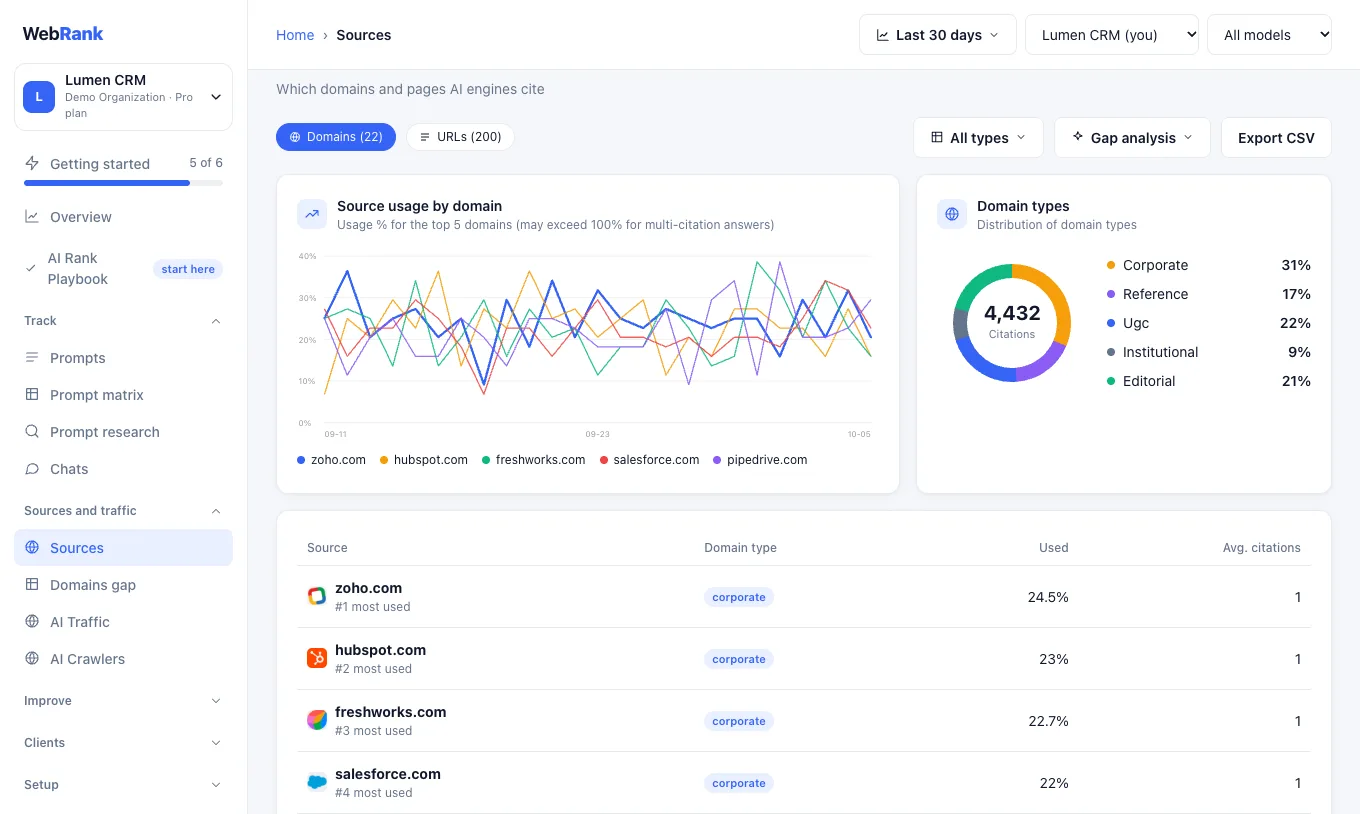
Screenshot and illustration use sample data.
Sources and Citations
What is Sources and Citations?
Source and citation analysis shows which websites and exact pages AI assistants cite when they answer questions about your market. In WebRank, the Sources page ranks the domains cited most often across your tracked answers, labels each by type, and lists the exact articles behind them.
By the WebRank team · Updated
Key terms
- Citation
- A link an assistant used as a source in an answer.
- Source type
- Corporate, user-generated, reference, editorial or institutional.
- URL type
- The format of the cited page, such as listicle or comparison.
- Share of answers
- The percentage of answers that cited a domain.
Why does it matter?
Assistants lean on a small set of third-party sites to decide which brands to recommend. If a comparison article, review site or forum thread keeps getting cited, being present on it is one of the few levers that changes what assistants say.
Knowing the kinds of pages that win also tells you what to make. If assistants cite listicles and comparisons rather than product pages, a product page alone will not be enough.
What you can do
Domains and pages
The domains cited most often across your answers, with the share of answers that used each one, and the exact article behind them.
Source types
Corporate, user-generated, reference, editorial or institutional, so you see whether AI trusts forums, review sites or news.
URL types
Listicle, comparison, how-to, product, discussion and more, so you know what format wins.
Real titles and clean links
Where the assistant reports a page title WebRank shows it, and tracking parameters are removed from links.
How it works
How does Sources and Citations work?
Every saved answer that includes citations contributes its links. WebRank cleans tracking parameters, resolves Google redirect links to the real article where possible, and counts how many answers used each domain and each page. Domains are typed as corporate, user-generated, reference, editorial or institutional, and pages are typed by format: homepage, comparison, alternative, listicle, how-to guide, product, category, profile, article or discussion.
Where an assistant reports a page title, WebRank shows it. Otherwise it shows the website address and a readable title taken from the link. The page can be filtered by period, brand and assistant, and exported as CSV.
- 01Open SourcesChoose the period, brand and assistant.
- 02Read the rankingStart with the domains cited most often.
- 03Open the pageSee why it was cited and who else is on it.
Illustration with sample data.
Across your answers, a review site is cited in 35% and a popular forum in 18%, while your own site is cited in 4%. The cited pages are mostly "best X" listicles. The takeaway is to earn a place on the two or three listicles that get cited, and to publish your own clear comparison page.
DoTips for getting it right
- Start with the top five domains. They usually hold most of the influence.
- Open the cited page and ask why a competitor is there and you are not.
- Look at URL types to decide the format you need to produce.
- Use the assistant filter, because Perplexity and Gemini show sources while others do not.
KnowWhat it cannot do
- –Not every assistant shows its sources, so the list comes mostly from those that do.
- –A citation means the page was used, not that the answer agreed with it.
What are the common mistakes?
Who uses Sources and Citations?
What you will be able to say
Questions people ask
Do all assistants show their sources?
No. Perplexity and Gemini show them, others do not, so a source list comes mostly from the assistants that cite.
Can I export the list?
Yes, as CSV or through the API.
Why does a link show a title?
Where the assistant reports a page title WebRank shows it, and tracking parameters are removed from links.
What do the source types mean?
Corporate sites belong to companies, user-generated sites are forums and social platforms, reference sites are encyclopedias and directories, editorial sites are publishers, and institutional sites are government and education.
Is my own site counted?
Yes. Your site is marked as corporate and you can see how often it is cited.
Domains Gap
The places assistants cite where your competitors appear and you do not.
Recommendations and AI Rank Playbook
A guided, ordered plan to get recommended, with results measured before and after.
AI Crawlers
Which AI bots read your site, which pages they visit and where they fail.
Find out what AI says about your brand
Start a 3-day free trial with every feature open. Cancel before it ends and pay nothing.
Start free trial