Find the questions people ask ChatGPT and Google AI Overviews
Type a keyword and a country. WebRank lists real questions and searches, with an estimate of how often they happen, so you track the prompts that matter instead of guessing.
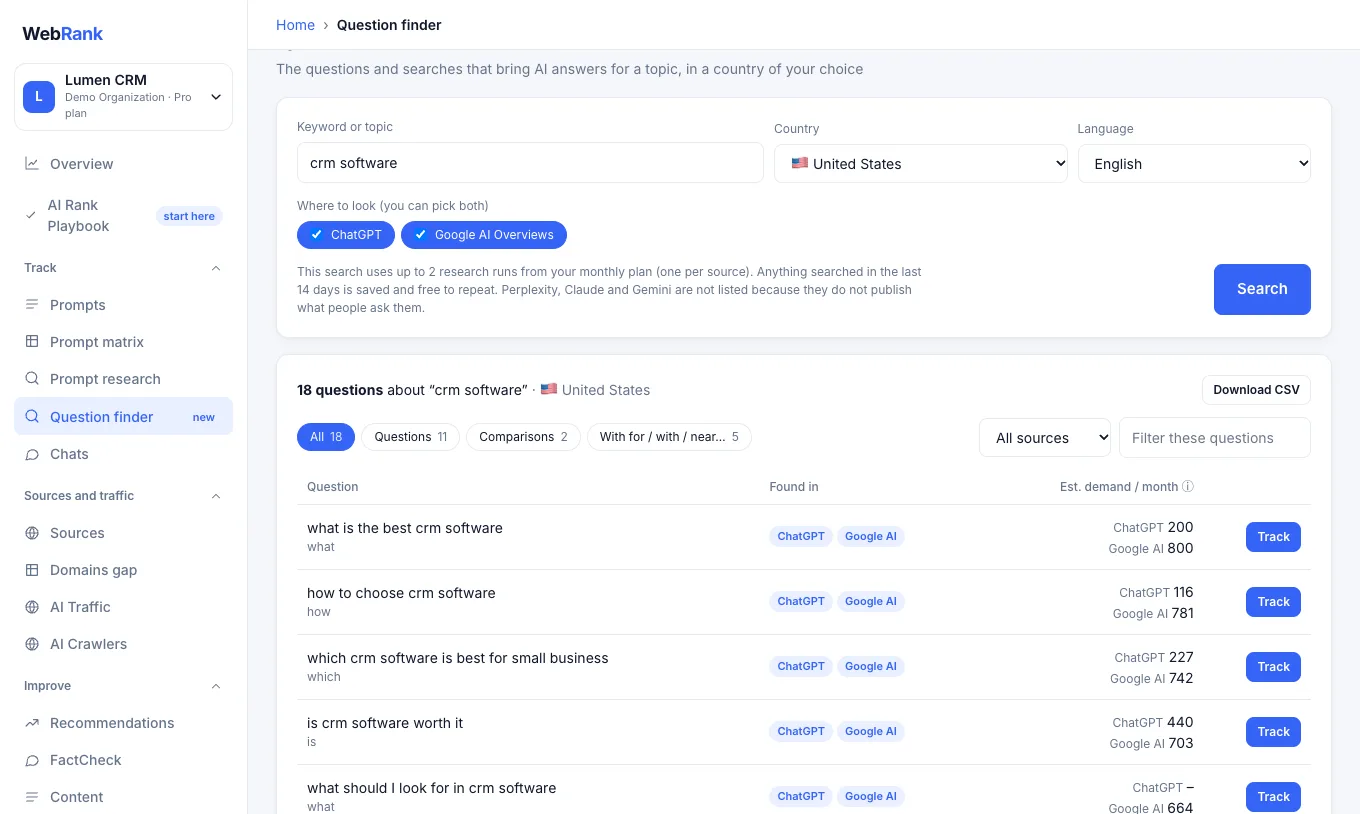
Screenshot and illustration use sample data.
Question Finder
What is Question Finder?
The Question finder shows what people ask AI assistants and which Google searches trigger an AI Overview for any topic, in about 90 countries, with an estimate of demand. In WebRank it is how you decide which prompts to track, instead of guessing which questions your buyers ask.
By the WebRank team · Updated
Key terms
- Question
- A full-sentence query, such as "what is the best CRM for a small team?".
- Comparison
- A query with "vs", "versus" or "alternatives".
- Keyword
- A plain search term that shows an AI Overview.
- Estimated demand
- A modelled or measured monthly volume. Compare rows from the same source only.
- Research run
- One search on one source, counted against your plan.
Why does it matter?
Most teams choose prompts from intuition, and intuition is biased toward how the company talks about itself. Real questions use different words, and some have far more demand than others. Starting from observed questions means your tracking reflects the market.
Demand estimates also help you rank your work. A question asked often is worth a page and a prompt. One asked rarely may not be.
What you can do
Ideas made for your business
Open the page and you already see questions your buyers may ask about your category, made once for your business. Opening them is free.
Two sources, kept apart
ChatGPT questions come with a modelled monthly estimate. Google AI Overviews searches come with monthly Google searches. The two numbers measure different things, so they are never added together.
About 90 countries
Google AI Overviews data covers about 90 countries and many languages. ChatGPT data exists for the United States in English only, and the page says so instead of guessing.
Sort and filter
Tabs for questions, comparisons, "for / with / near" phrases and keywords. Filter by a word, choose one source, download a CSV.
One click to track
Press Track and the question joins your daily prompts on every assistant you enabled.
How it works
How does Question Finder work?
You type a keyword, choose a country and language, and pick where to look: ChatGPT, Google AI Overviews or both. The two sources return different data and are kept apart. ChatGPT rows are full-sentence questions with a modelled monthly estimate. Google AI Overviews rows are searches that show an AI Overview, with monthly Google searches.
Real questions are listed first, then comparisons, "for / with / near" phrases and plain keywords. Anything searched in the last 14 days is saved, so repeating it is free. Pressing Track adds the question to your prompts so every enabled assistant is asked daily.
- 01Search a topicChoose a keyword, a country and a language.
- 02Read the demandReal questions come first, then comparisons, then plain keywords.
- 03Track the winnersAdd the ones that match your buyers to your prompts.
Illustration with sample data.
You search "payroll software" for the United States on both sources. You see questions such as "what payroll software is best for a 10 person company?" with a modelled estimate, and keywords such as "payroll software" with monthly Google searches. You track the three questions closest to how your customers speak, and write a page for the one with the most demand.
DoTips for getting it right
- Search around your product category, your customers' problems and your competitors' names.
- Use the Comparisons tab to find "alternatives to" questions, which are close to a buying decision.
- Treat numbers as relative. They are estimates that help you compare, not exact counts.
- Open the free ideas made for your business first, then search wider topics.
KnowWhat it cannot do
- –ChatGPT question data exists for the United States in English only. For other countries that option is greyed out.
- –Perplexity, Claude and Gemini publish no data about what their users ask, so no tool has real numbers for them. You can still track any question on all of them.
- –The ChatGPT data provider does not publish how its questions are collected, so every volume is a modelled estimate.
What are the common mistakes?
Who uses Question Finder?
What you will be able to say
Questions people ask
Where does the data come from?
A third-party database of AI assistant responses and Google search data. The provider does not publish how ChatGPT questions are collected, so every volume is a modelled estimate that is useful for comparing rows from the same source, not an exact count.
Why not Perplexity, Claude or Gemini?
They do not publish what their users ask, so no tool has real data for them. We prefer to show nothing over inventing it. You can still track any question on all of them.
What does a search cost?
A search uses research runs from your monthly plan, one per source. The page shows the number before you search, and anything searched in the last 14 days is saved and free to repeat.
Which countries are covered?
Google AI Overviews data covers about 90 countries and many languages. ChatGPT data covers the United States in English.
Can I download the list?
Yes, as a CSV, with the question, type, source and estimated demand.
Is the ideas list free?
Opening the ideas made for your business is free. A new set uses one research run.
Prompts and Prompt Matrix
Choose the questions to track, group them, and see how every brand performs on each one.
Recommendations and AI Rank Playbook
A guided, ordered plan to get recommended, with results measured before and after.
AI Content and Optimization
Write and improve pages in the form assistants quote.
Find out what AI says about your brand
Start a 3-day free trial with every feature open. Cancel before it ends and pay nothing.
Start free trial