Understand not just whether AI mentions you, but how it talks about you
A mention is not always a win. WebRank reads the sentences around your name to show how you are framed and which criticisms assistants repeat.
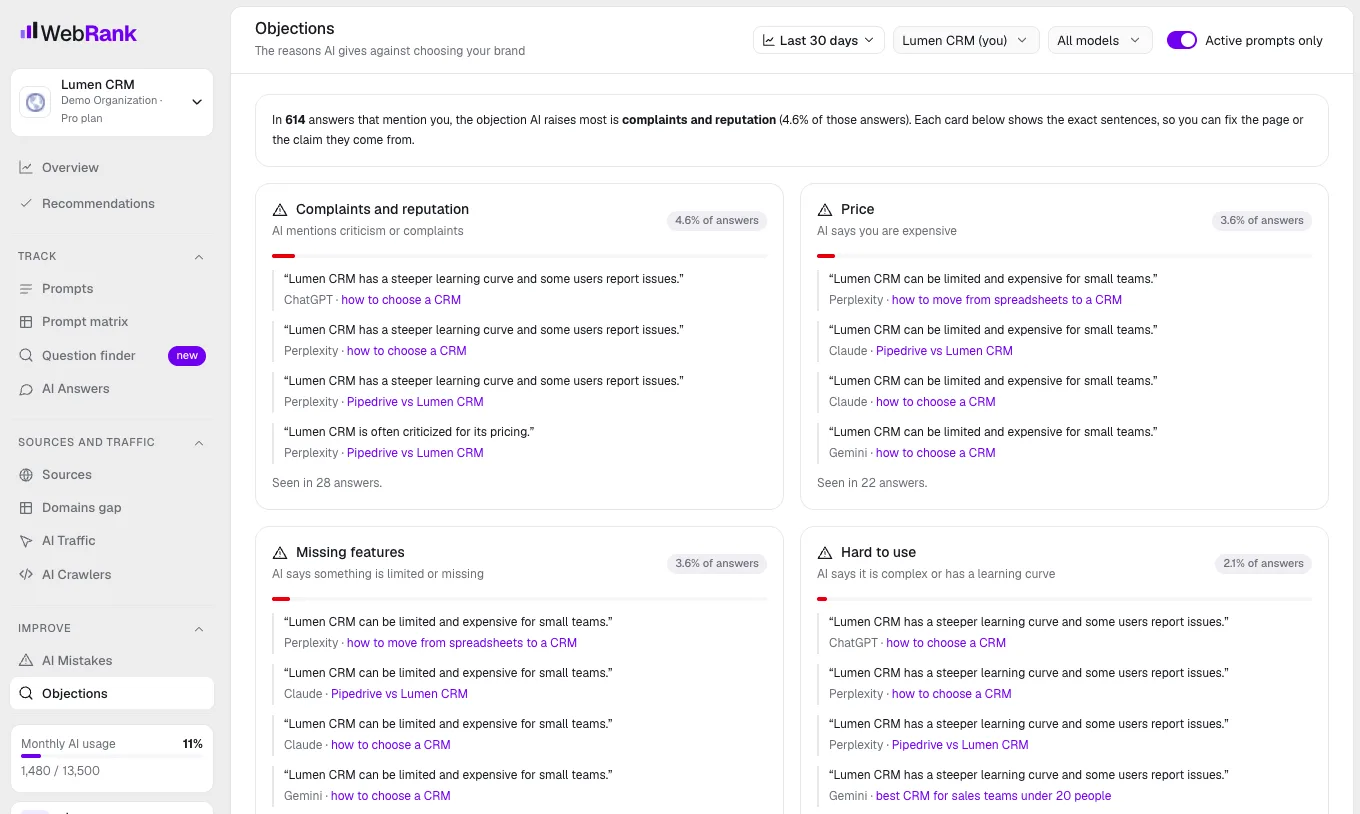
Screenshot and illustration use sample data.
Framing, Sentiment and Objections
What is Framing, Sentiment and Objections?
Framing and objections analysis shows how AI assistants talk about your brand once they mention it. WebRank classifies each mention as a primary recommendation, a viable alternative, a neutral reference, a passing mention or a cautionary one, and it groups the sentences that argue against you into themes such as price, ease of use and missing features.
By the WebRank team · Updated
Key terms
- Primary recommendation
- Named as the best or top choice.
- Viable alternative
- Offered as a good option next to others.
- Neutral reference
- Named without praise or criticism.
- Mentioned in passing
- Appears late in a long list.
- Objection
- A sentence that argues against choosing you.
Why does it matter?
A mention is not always a win. Being named last in a list of ten, or named with a warning, is very different from being the first recommendation. A visibility score that treats them the same hides the problem.
Objections are the most actionable text in any answer. They tell you the exact reason an assistant gives for not choosing you, and that reason usually traces to a page, a review or a missing fact you can change.
What you can do
Framing
For each prompt: primary recommendation, viable alternative, neutral reference, mentioned in passing, or negative and cautionary.
Objections
The sentences that argue against you, grouped by theme: price, hard to use, missing features, support, speed and reliability, not for everyone, and complaints.
The exact sentences
Every theme shows the real wording, which assistant said it and for which prompt, so you know which claim or page to fix.
Sentiment
Positive, neutral or negative per mention, rolled up per prompt and per brand.
How it works
How does Framing, Sentiment and Objections work?
Only answers that name your brand are analysed. For each mention WebRank reads the line around your name and your position in the answer. A negative cue makes it cautionary. Being first, with strong praise or early in the answer, makes it a primary recommendation. Cues such as "alternative" or a position in the first four make it a viable alternative, and late positions are passing mentions.
Objection sentences are found by looking for fixed phrases in seven themes: price, hard to use, missing features, support, speed and reliability, not for everyone, and complaints and reputation. Each theme shows how many answers contained it, its share of answers that mention you, and the exact sentences with the assistant and prompt they came from. The analysis is rule-based, so it costs no extra AI run.
- 01We read the answersOnly answers that name you are used. No extra AI runs are needed.
- 02Sentences are groupedCriticism is sorted into themes and counted.
- 03You actFix the page, add the missing fact, or answer the objection in your content.
Illustration with sample data.
In 40 answers that mention you, 8 contain a price objection (20%) and 3 mention a missing integration (7.5%). The price sentences all say "premium pricing" in the same comparison article. You now know which article to answer and which claim to address on your pricing page.
DoTips for getting it right
- Read the sentences, not only the percentages. Rules can miss nuance.
- Trace each objection to its source with Sources and the prompt page, then fix the source.
- Answer your biggest objection on your own site, in plain language, with evidence.
- Re-check after a few weeks to see whether the share falls.
KnowWhat it cannot do
- –The analysis is based on wording rules, not understanding, so it can miss subtle criticism or flag a harmless sentence.
- –If assistants never mention your brand there is nothing to analyse. The page tells you so and suggests a prompt that names you.
What are the common mistakes?
Who uses Framing, Sentiment and Objections?
What you will be able to say
Questions people ask
How is this measured?
By rules on the wording, not by another AI call, so it is free and repeatable. Rules can miss a nuance, so read the sentences, not only the counts.
What if AI never mentions us?
Then there is nothing to analyse yet. The page tells you so and suggests adding a prompt that names your brand.
What are the objection themes?
Price, hard to use, missing features, support, speed and reliability, not for everyone, and complaints and reputation.
How is framing different from sentiment?
Sentiment is positive, neutral or negative. Framing also uses your position and the strength of the recommendation, so it separates "first choice" from "also exists".
Can I change the rules?
Not yet. Tell us at support@webrank.si if a theme or phrase is missing.
Find out what AI says about your brand
Start a 3-day free trial with every feature open. Cancel before it ends and pay nothing.
Start free trial